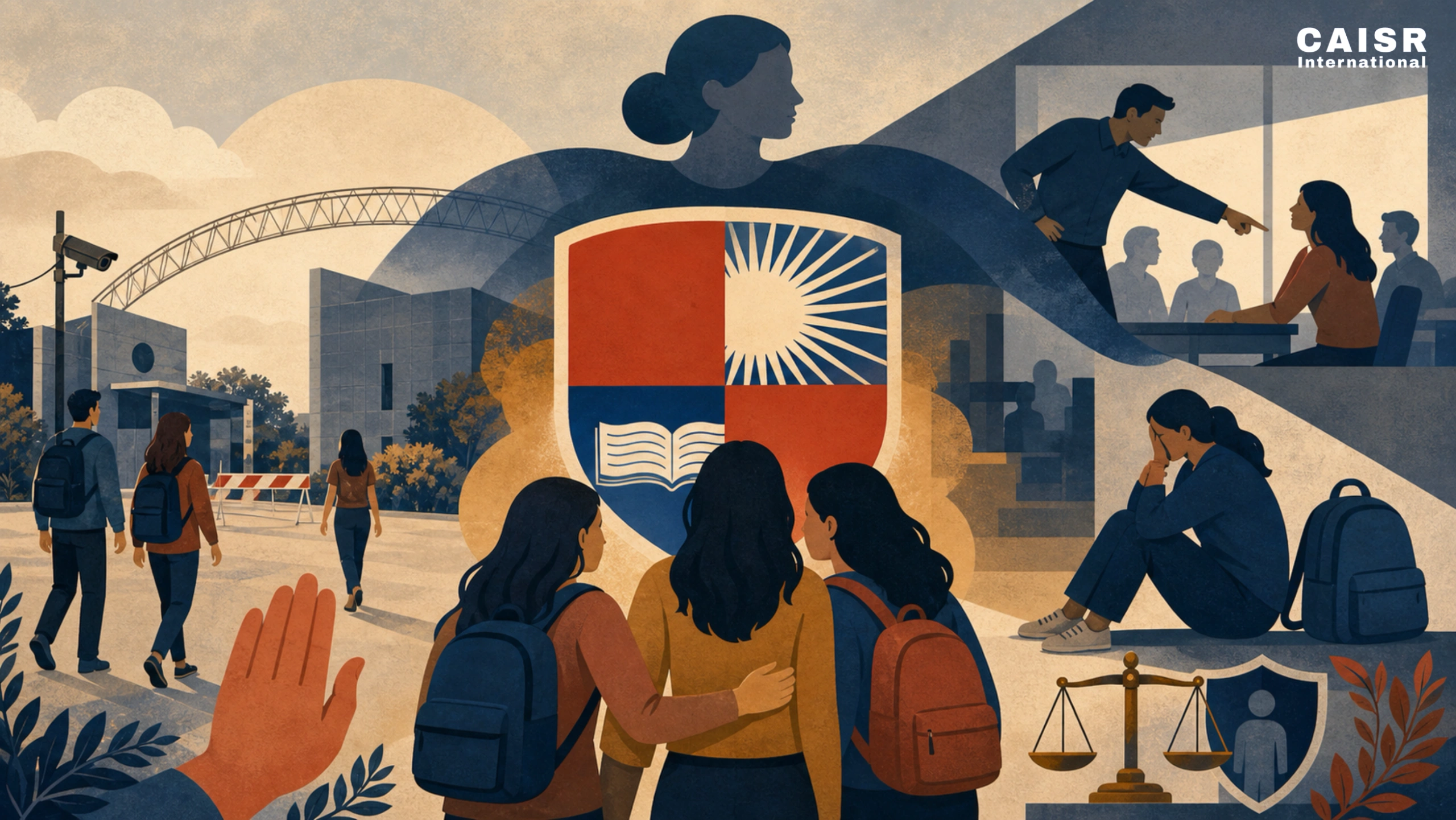
The focus of workplace safety conversations in India has largely been on formalities of the employer-employee relationship, for decades. Our system of laws, such as the framework of the POSH Act, industrial safety laws and internal grievance redressal procedures are specifically developed for wage earning adults. What is often missing from the equation is an educational environment that is not only as unequal, but usually much more so: the typical college classroom and campus of today.
The recent controversies at Nirma University in Ahmedabad are an unpleasant reminder that the safety of students, not only from a physical standpoint but also in the absence of fear and intimidation in the institution, is a serious issue that needs to be addressed systemically like workplace safety issues.
Anatomy of an Escalation: Hostel Security Lapses and Institutional Apathy
Recent troubling incidents of security and administrative issues have highlighted the need for this conversation and are now being broadcasted on a national level. Uncomfortable security and administration issues have been brought into focus by recent viral videos and student disclosures on campus.
The Girls' Hostel Privacy and Safety Crisis
Videos were recently found of the man allegedly indulging in a sexually obscene act near the blocks of the girls' hostel at the university (around the area of H5 block, where construction works are in progress, adjacent to the hostel). The video was taken by students who were located on the side of the construction site, and led to a formal verification and investigation by the police.
Student accounts and emails were made public of the incident, and it was seen to be a lack of security: previously, female students had complained about workers peering into or lingering near the hostel blocks, but such student complaints were brushed aside by the security staff, who instructed the students to “not wear shorts within the hostel.”
Adding to these woes, students have also made complaints about teachers' overbearing and misogynistic remarks or threats to them, a stark contrast to a university that claims to promote women empowerment.
Why This Is a "Workplace Safety" Issue
As someone that has never dealt directly with a college campus hostel or faculty intimidation issues, it may seem like a stretch to use labour law or workplace safety to understand the security breakdown in the campus hostel or the intimidation of faculty. But the structural resemblance is not as evident when examined carefully.
A university classroom or campus residential facility is a space – much like a corporate office or factory floor – which is chock full of institutional hierarchy. A professor has direct influence on a student's academic performance and future career path, and is responsible for evaluating their assignments, assigning grades, writing recommendation letters, etc. The power of a manager to dictate career promotion and job security is pretty much the same.
Structural vulnerability is the one that this implies the fear that raising a voice to express disagreement with unsafe working conditions, or complaints of administrative indifference will lead to institutional counter-attack and this is exactly what workplace safety and harassment laws are supposed to address, and negate.
India's laws and legislations recognise that there is a need for formal, codified protection for the unequal power relationships and not on the basis of goodwill. If, on the other hand, a parallel imbalance occurs within higher education (such as administrators' negligence in the security of women's hostels, for example, or security personnel's tendency to blame the victims for incidents, or the lack of concern from faculty about women's safety, for example), there is no equivalent statute with comparable enforcement powers.
While the University Grants Commission (UGC) Regulations, 2015 explicitly mandate Internal Complaints Committees (ICCs) to protect both employees and students from sexual harassment, there is no broader statutory framework giving students the same formalized protection against non-sexual privacy violations in residential areas or psychological intimidation by faculty as corporate employees receive under general labour laws.
The Pattern Beneath the Incidents
The irony of the Nirma University situation is not only in the isolated incidents of poor judgment, but that when issues about students arise, the immediate response tends to be more of a containment, denial or victim-blaming game instead of an open and honest accountability mechanism.
- The 2019 Protest Episode: The university has been plagued by accusations of sending emails to parents in warning of "counselling" students before and after campus protests, and of logging police records against those taking part in the demonstrations, years ago.
- Hostel and Infrastructure Delays: The events in relation to the accommodation for the student and the readiness of the infrastructure have also created tension between the parent body and the University management; and issues are frequently stuck in the 'backchannels'.
- The Recent Hostel Privacy Lapses: Campus Security's answer to the recent privacy lapses at the hostels – to change clothing instead of provide protection to the perimeter to ward off outside voyeurism – is illustrative of a culture of administrative deflection.
In both cases, the institutions' response supports a “private” and “non-public” resolution of the issue, with apologies and damage control preferred over a responsible, transparent investigation.
This is because students have a much less powerful institutional position than do employees in the corporate sector. If a worker is in a hostile work environment or sees a safety issue, he/she may choose to resign, go to a labour court, or escalate to outside statutory agencies. The formal options to the student who is subject to a compromised hostel security or intimidation from faculty members are limited—either bring the complaints to the institution whose staff is accused of the behaviour or keep his or her mouth shut and wait it out.
What Must Change to Close the Gap
The accountability gap between the corporate world and academic institution needs to be filled in in order to achieve meaningful reform. This can be accomplished in three ways in the structure:
- Enforcement of Independent Grievance Mechanisms: While the UGC (Redressal of Grievances of Students) Regulations, 2023 already legally mandate Students' Grievance Redressal Committees (SGRCs) and an independent Ombudsperson, strict regulatory action must be taken against universities that fail to implement these mechanisms in spirit, ensuring they operate free from departmental hierarchy and institutional bias.
- Mandatory, Time-Bound Inquiries: Inquiries into faculty or staff incidents of privacy violations, threats and abuse of power should be transparent, time-bound, with clear outcomes, and published and not conducted “behind the scenes” with settlements, or victim-blaming answers.
- Empowered External Oversight: There must be greater clarity in giving empowered external oversight to student unions, parent associations and regulators such as the UGC to oversee campus conflicts and the safety of the campus-related accommodations, so that accountability doesn't rely on a video going viral.
Landmark Judgments on this issue
A precedent-setting Supreme Court case, M.S. Grewal v. Deep Chand Sood, is a fundamental precedent when considering the education sector's accountability for failing to keep its campuses safe. In this instance, students drowned in a school organized excursion as a result of negligence of the staff, the Supreme Court clearly set out that the schools are vicariously liable for the wrongful acts, omissions or negligence of their staff. In this case, the Court determined that school and universities have a non-delegable duty of care for students placed in their care, noting that they are in a "special relationship" to the students. It is clear from this precedent that if a school fails to properly secure the premises or if an educator or other employee fails to do so, then the institution is not protected from financial or legal liability as a result of such inadequacies.
The decision of the Kerala High Court in Anjitha K. Jose v. State of Kerala (2019) offers significant insights for judicial interpretation when it comes to privacy rights and excessive administrative limitations in relation to student accommodation for the purposes of residential safety. While the High Court declined to strike down the hostel curfews, holding that return timings are an administrative disciplinary matter for the management, it did rule that forms of moral policing, such as prohibiting female students from attending certain movie shows or participating in political activities, were discriminatory and unconstitutional. The Court found that the regulations of institutions must have a direct and rational connection to actual discipline and security, and that it is not acceptable for universities to justify "paternalistic" restrictions or "victim-blaming" rules, which could include monitoring student clothing and movement, as a way of concealing the fact that the institution is not providing a secure, private, and well-regulated residential setting.
Conclusion
As new news cycles come and go, the controversies at Nirma University will be pushed to the back of the news. But the basic issue they raise must endure past the initial feeling of outrage: what if there is a power imbalance in place that requires strong protection mechanisms in modern legal systems, why should the protection not extend past the campus gate?
It is not a radical idea to treat safety an idea that could naturally occur in the classroom and residential hostel where pupils are under the care of the school like employees are under the care of the management. It's a acknowledgement of power realities, which are part and parcel of modern higher education.