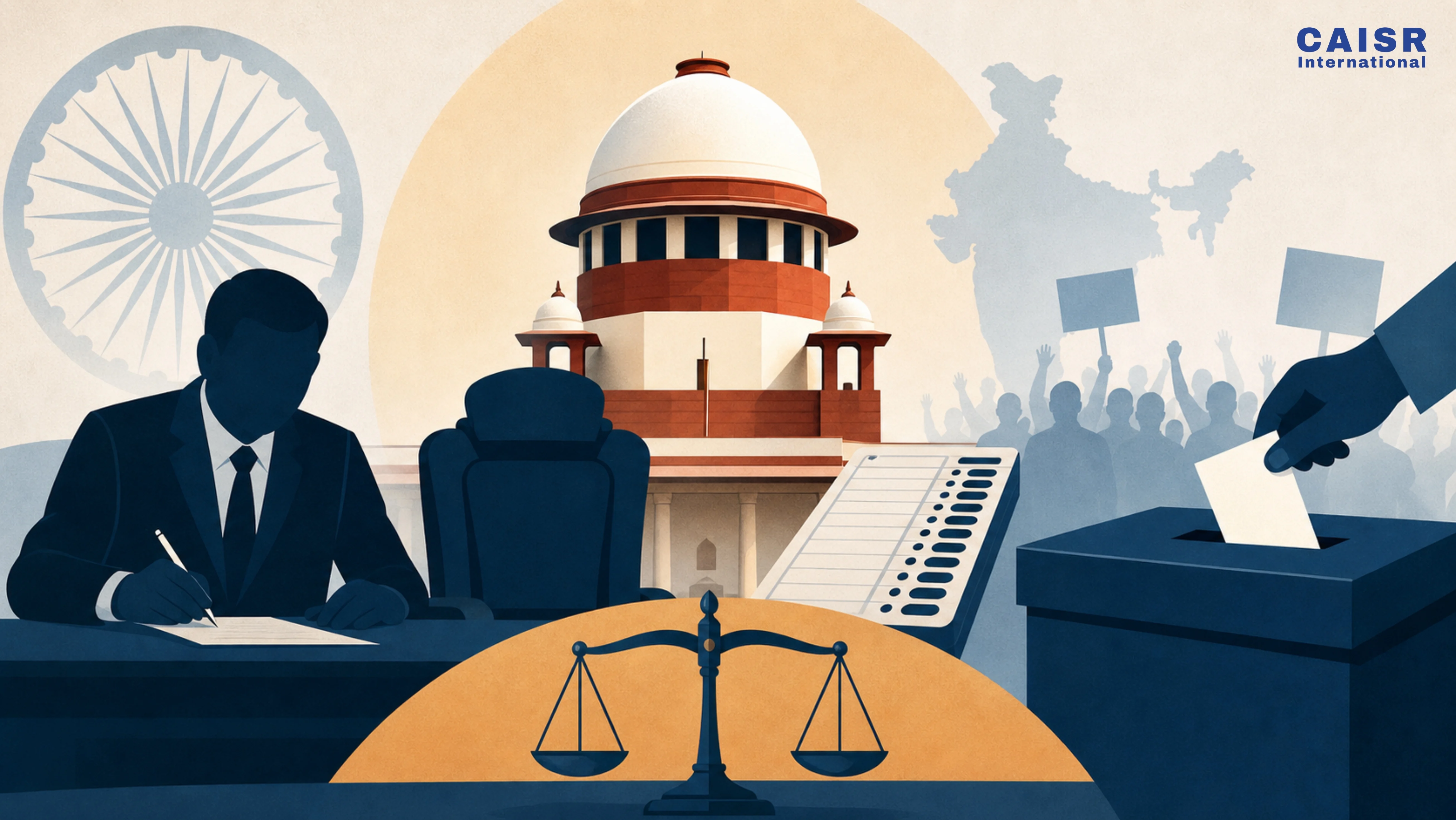
Election Commission of India (ECI) is a permanent election commission as laid down in the Constitution. The ECI has extensive powers in respect of Parliament's and State Legislatures' elections as well as in the context of the Presidential and Vice-Presidential elections. The ECI differs from the claim that it was an act of Parliament: it is a constitutional body and is established by the Constitution itself. Elections are conducted by the ECI under different directions and laws. This has given ample opportunity to the ECI to be involved in various judicial and public debates.
The following are debates regarding the appointment, the independence of ECI after appointment, and the exercise of power by ECI. The purpose of this paper is to describe these debates and list the controversy surrounding each of them. Furthermore, the perspectives of the advocates in these cases have been cited in this article.
Constitutional Mandate
The supervision, management, and conduct of elections is vested with the Election Commission for Parliament, State Legislatures, and the President and Vice-President's offices under Article 324. Parliament can determine the terms and conditions of service and the tenure of members of the Commission, and can make laws in this regard.
The remaining provisions of Articles 325 – 329 relate to preparation of a common and comprehensive Electoral Roll for all constituencies, adult suffrage, delimitation of constituencies, and restriction on the jurisdiction of courts to review or challenge the validity of any law, other than an election petition, relating to elections.
The Commission operated under a single member until 1989, and was formed as a multi-member Commission in October 1989, only to revert to a single member in January 1990, and then again to a multi-member Commission in October 1993; since then, it has been composed of three members.
The CEC and the Election Commissioners are given varying levels of protection by the Constitution. Article 324(5) provides that the provision of the Constitution which protects Supreme Court judges from removal of office also applies to the CEC. Likewise, no Election Commissioner can be removed from office unless he or she is recommended to do so by the CEC. Supreme Court in T.N. Seshan, CEC of India v. Union of India (1995) ruled that the protection from removal granted to the CEC is constitutional. Further, in conducting the business of the Commission, the CEC does not have a superior position compared to the other Commissioners; the Commissioners are not subordinate to the other Commissioners, but rather are first among equals.
The Appointment Process: A Continuing Dispute
Until now, Parliament had never passed any particular act on the appointment of members of the Election Commission of India under Article 324(2), with the Union Council of Ministers being the ones to fill the posts. The absence of a statutory process was raised as being in breach of the independence of the Commission.
In Anoop Baranwal v. Union of India (2023), a Constitution Bench of the Supreme Court of India held that, prior to enactment of relevant legislations by Parliament, the CEC or Election Commissioners would be appointed by the President on the advice of a committee of three members namely the Prime Minister, the Leader of the Opposition in the Lok Sabha and the Chief Justice of India.
Thereafter, Parliament enacted the Chief Election Commissioner and Other Election Commissioners (Appointment, Conditions of Service and Term of Office) Act, 2023. In place of the Chief Justice of India, this Act created a selection committee headed by the Prime Minister, a nominated Cabinet Minister, and the Lok Sabha Opposition leader.
The advocates of Article 324 contended that the procedures for appointments are open to Parliament to make because Article 324 does not remove the Leader of the Opposition and retains a consultative check. Those opposing the move suggested that a compromise had been reached during the Chief Justice's tenure, which would be lost if the Chief Justice was replaced, and questioned the judicial balance and independence that had been established in Anoop Baranwal. The President of India appointed Gyanesh Kumar as Chief Election Commissioner under the new arrangement in February 2025, in spite of the objections voiced by the Leader of the Opposition.
Institutional Independence in Practice
The internal working of the Commission is an important element of its independence. In past years there have been significant hurdles for the Commission to deal with when it is being actively used in the enforcement of the Model Code of Conduct, particularly during the period of T.N. Seshan as CEC between 1990–1996. Supporters attribute Seshan's ability to restore the Commission's reputation to his tougher enforcement policies, while critics argue that he led to a reaction that resulted in administrative restraint in the future. More recently, the roll revisions issue has been the cause of conflict within the Commission, underlining the issue of consensus-driven government versus Commissioners' autonomy.
The Special Intensive Revision of Electoral Rolls
In 2025, the Commission announced a Special Intensive Revision (SIR) of electoral rolls in Bihar ahead of State Assembly elections, which was last done in the state in 2003. The ECI justified the re-verification exercise on the grounds of urbanisation and migration, as well as demographic changes.
In response to petitions filed by the Association for Democratic Reforms (ADR) and opposition leaders that the ECI is disenfranchising people, the Supreme Court ordered an increase in the list of accepted ID proofs (Aadhaar, ration cards, and voter ID cards). The Supreme Court in Association for Democratic Reforms v. Election Commission of India (2026) after the release of new rolls in September 2025 ruled the measures taken by the Commission as valid.
Electronic Voting Machines and VVPAT Verification
The Electronic Voting Machines (EVMs) have also been deployed in Indian Elections since 2004 and in addition since 2013, by the Voter Verified Paper Audit Trail (VVPAT). The ECI's stance on the petitions demanding 100 per cent verification by VVPAT (Association for Democratic Reforms v. Election Commission of India, 2024) was that its random sampling verification system is statistically sound and logistically necessary.
The Supreme Court ruled that 100 percent manual verification of VVPAT slips cannot happen, but it directed that second- and third-place candidates can demand a technical verification of the microcontrollers (burnt memory) in 5% of the EVMs per assembly segment at their own cost; however, issues around EVM transparency continue to be debated in public discourse.
A Recurring Structural Question
The controversies over the ECI stem from a persistent structural dynamic of separating the electoral process from the work of the executive and keeping it open, transparent, and public. Article 324 of the Constitution offers minimum protection and gaps are filled by the practice of institutions, Parliament, and the judiciary. Judicial review, dissent, and legislative changes are mechanisms that continue to influence the precarious relationship between power in India's electoral democracy.
Key Authorities and Sources Referred To
- T.N. Seshan, Chief Election Commissioner of India v. Union of India, (1995) 4 SCC 611
- Anoop Baranwal v. Union of India, (2023) 6 SCC 161
- Chief Election Commissioner and Other Election Commissioners (Appointment, Conditions of Service and Term of Office) Act, 2023
- Association for Democratic Reforms v. Election Commission of India (VVPAT verification), 2024 INSC 341
- Association for Democratic Reforms v. Election Commission of India (Bihar SIR), W.P. (C) No. 640/2025, 2026 INSC 564
- Constitution of India, Articles 324–329