A Consumer and Worker Perspective on Accountability, Algorithmic Management and the Future of India's Platform Economy
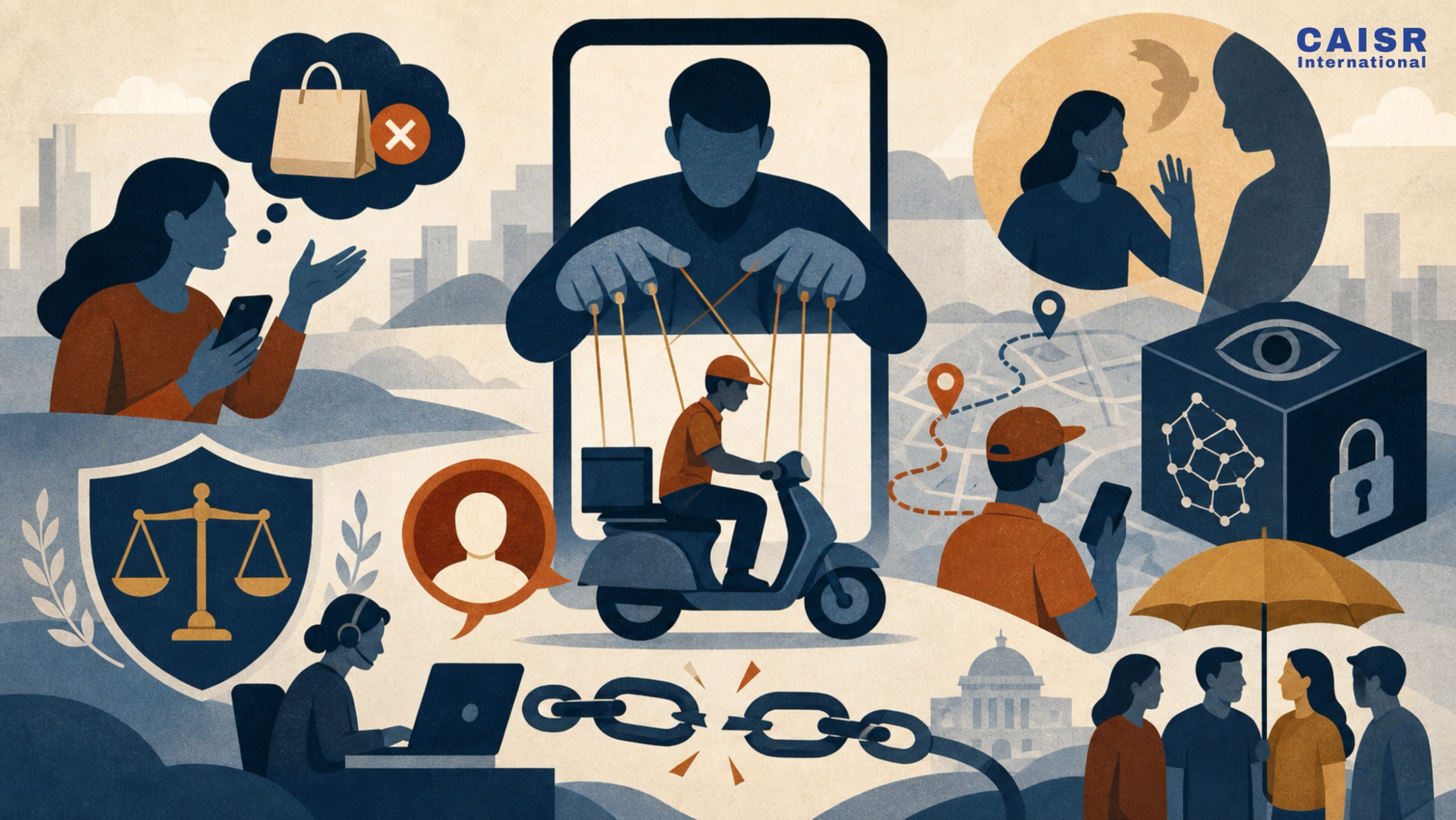
The delivery economy was created around the promise of convenience. However, it has created a situation where customers cannot contact the workers, where workers cannot interact with the systems that control their jobs, and where companies can control every aspect of the delivery process.
Convenience for Whom?
Not long ago, when you wanted food from a particular restaurant, you called the restaurant and placed an order. If there was a problem with your food, you could contact the restaurant to help you solve the problem. Then the world of work changed with the introduction of the online food delivery systems and the delivery of almost anything over the Internet. Customers could arrange for the transport of almost anything over the Internet.
Now that we have these incredible delivery systems, we should ask: at what cost did convenience enter our lives? People have come to depend on delivery systems controlled by large companies and logistics services. People have also come to depend on these systems for their livelihoods. However, consumers and workers do not have as much control over their systems as the companies would lead them to believe.
Exhibit A: “Delivered” - But Delivered to Whom?
There is not much that can frustrate a user like seeing their order status change to delivered when in reality nothing has been delivered. Users lose money and faith in the system. Users are charged service fee and the system takes away the partner’s chance of earning by doing the delivery, all while the user doesn’t even get to experience the service. Reports filed by the users have highlighted this issue. One such report mentioned a user experiencing this with Zomato. The user paid and did not receive the service and the order status was set to delivered. Other users also mentioned experiencing similar issues with Zomato, and other food delivery systems as well. One user even mentioned how they were not able to contact their delivery partner after their order was delivered. There are similar reports from August and July 2026. In the July report, the customer claimed the delivery partner didn't go to the society to receive the delivery. However, the order was marked as 'delivered' by the system. The customer claimed he/she approached Zomato's AI-based chatbot to provide evidence and to know the delivery location. In the August report, the customer claimed an order was prepaid and was handed over to a 3rd person and the order was marked as 'delivered' by the system. The customer was not able to contact the Delivery Partner or Zomato's Support team. These are the thoughts and complaints shared by actual customers. These demonstrate customers are at the receiving end of Zomato's delivery system. Resolving the financial transaction (a refund) does not answer questions regarding delivery Partner's account or the investigation conducted by Zomato.
Exhibit B: The Multi-Order Delivery Problem
The second issue is more nuanced. Consumers are shown an approximate delivery window. Food is prepared based on that window. A delivery partner is then dispatched to pick up the food, and may even leave the restaurant with the food, but may end up taking a long, roundabout route to the destination or delivery window. It is possible that the delivery partner is routing optimally by taking the shortest route to the various destinations to which multiple orders have been assigned. Users have identified and raised concerns about this practice. For example, in 2026, a Reddit post documented users’ concerns and questions about the clubbing of orders, and reasons for orders being delivered cold. There are differing views on the ethics of a delivery partner combining multiple orders. From an economics of services and delivery perspective, it can improve the delivery partner’s average hourly earnings by reducing empty runs. However, delivery partner service combinations should be disclosed. For example, users should be notified if their order is being combined with a separate order for delivery. Further, if a user pays for a priority or expedited delivery, the service should deliver the food first in the combination before delivering the other order. Many users are not opposed to the combination of orders; rather, users are concerned that they are not given any control over the delivery service combination..
Exhibit C: When “Picked Up” Becomes a Black Box
Roughly the same issues can be seen in local or intercity delivery. In the case of Porter, the service is between the consumer and the service provider. Complaints from consumers show that packages may be collected but not delivered, or consumers may have to follow the delivery to the destination city. Consumers may have to make several calls to the service provider but may not be able to get a satisfactory explanation. According to a consumer complaint dated May 2025, a rider picked up the package but did not deliver it. The consumer was unable to get a solution through the service provider’s complaint process. In another complaint, the consumer reported that the package reached the destination city (Bengaluru) but the service provider did not deliver it and the consumer made several calls to the service provider. Service providers may have an electronic system to track the status of a package but may not have a sufficient explanation of the status to communicate to the consumer. Clearly, the package delivery process is opaque. The service provider may not have adequate control over the process. The service provider may have to depend on the service company for control of process information.
Exhibit D: When Convenience Becomes a Personal Safety Problem
Another reason for bad interactions that can’t be attributed to just poor customer service is bad behavior. Delivery partners (DPs) are independent platform workers operating under high stress, and like workers in any customer-facing role, conflicts and misconduct can occur. They know where you live. They can call you if they want to. They know when you will be expecting a delivery. Most of the time things will be normal. But things can easily get scary and unpleasant. There are several posts describing and accusing DPs of harassment, and verbal abuse. Until these are confirmed to be true, these should be treated as accusations. However, these posts are important because they raise a valid concern. What if the relationship between the customer and the service worker deteriorates? If the situation involves harassment or threats, then a standard customer support ticket will not help. An elevated support ticket is necessary.
Exhibit E: The AI Support Paradox
Delivery apps no longer just facilitate contact between customers and service providers. The technology has now evolved to create and reinforce barriers between customers and service providers. AI customer service is obviously useful for simple and repetitive queries. However, customers often require human intervention for more complex queries. For example, what if the customer’s order is shown as ‘delivered’ but the customer has no record of receiving the order? What if the customer has a query regarding a delayed order? AI would be of no use in these cases. AI should be used for repetitive customer queries and should be integrated to offer customer service only for queries for which human intervention is not required. There are several user reviews describing how customers were unable to contact human customer care representatives to resolve their queries after their orders were ‘marked’ as delivered. One such review is from 2025 and another is from 2026. These reviews illustrate that for some queries, especially those related to order fulfillment, customers should be allowed to bypass AI, and directly contact a human representative.
Exhibit F: The Last Mile of Logistics
There are similar issues with other sectors. With package delivery, a truck could be just a few kilometers away with a parcel, and the customer has to wait for another delivery attempt. Tracking systems can only update so much. Just because it says “arrived at local facility,” doesn’t mean an employee can tell you when it will be delivered. When the tracking system fails, customers try to find alternative ways to get updates. For example, in a conversation that took place in the Blue Dart forum in January 2026, a user provided the expected delivery time for a parcel that was still not delivered, and also asked for a local number that they could call to get an update. A tracking system can answer the question “do you know where my parcel is?”. However, it usually fails to answer the question “when can you deliver my parcel?” While modern tracking architectures can confirm the physical location of a parcel, they consistently fail to provide customers with actionable explanations for non-delivery.
But There Is Another Side to This Story
In acknowledging issues related to last-mile delivery systems, it would be hypocritical to relay that experience solely from the perspective of the end user. Someone stands outside your house with the food you ordered from an app. That worker did not design the system, nor do they control the algorithm that dictates their schedule.
The Worker Sees a Different App
To the end user of a delivery app, the interface allows them to place an order. However, to the delivery worker, the interface is everything. It is a manager. The delivery app determines which job is presented to the worker, how the work is assigned, how the worker’s performance is measured and evaluated, how the worker is rewarded or penalized, how long the worker has to fulfill the assignment, and ultimately, how and when the worker finds employment. This is what the International Labour Organization defines as “algorithmic” management. Flexibility in when a gig worker provides a service creates the illusion of control. In reality, the gig worker has no control over how the service is provided.
The Autonomy Paradox
When workers’ flexibility is restricted by, for example, algorithmic assignment to jobs, control by intermediaries over the volume of orders assigned, and/or the fact that employment opportunities are negatively impacted by workers exercising flexibility, the “gig” economy fails to provide the flexibility it claims to offer. Fairwork’s research into India looks at issues relating to pay, conditions, contractual relations, management and worker representation. Fairwork’s most recent India Report outlines some of the ways in which platform companies modify the duration and extent of the services which workers are required to provide. The absence of a standard employment relationship gives rise to issues relating to the security of gig economy workers’ employment, income and social protection.
The delivery person may answer the customer’s question as to why they took a subsequent order before delivering the customer’s order by explaining that they need to take multiple orders in order to earn a living. These contrasting views can be correct depending on the vantage point.
The Real Problem: The Platform Sits Between Two People
The customer thinks: Once I pay the platform, I am entitled to seamless, on-time service. The worker thinks: I take money through the company.
The platform usually has the most scope and insight into the financial transaction. The Platform has access to the customer's order, the worker's location and time stamps, the route the worker takes, assigned orders, support messages, order changes, cancels, ratings and complaints. The worker and customer have no access to that information and if something goes wrong, the platform is of little to no help in answering what actually transpired. This is the accountability gap.
So What Should Change?
- Tell consumers when orders are being clubbed: Customers should always be informed when their order is clubbed with another order. The delivery app should update the customer’s expected time of delivery based on when the order is clubbed with the other order and deliver other appropriate ETAS. Additionally, the customer’s expected time of delivery should update to indicate that the delivery person is about to make the first drop, and then the second drop. However, in this case, customer’s expected time of delivery and the other customer’s expected time of delivery should not be disclosed.
- Separate refund from investigation: Although the order is refunded when the app determines that the customer order was not fulfilled, the case should be further investigated. In cases where a customer reports that an order was delivered but not received, the case should be further investigated by the app, and the customer should be notified, “We have investigated your case and taken appropriate steps to resolve this.”
- Create a human escalation button: If a case involves a safety issue, order not received, fraud, harassment, or a payment dispute, there should be an immediate case escalation to a human.
- Give workers algorithmic transparency: Workers have the right to know why they received a negative rating or why their account was suspended or terminated. Further, workers should know how the algorithm determines the order in which deliveries should be made.
- Build a proper appeal system for workers: If an account is suspended due to customer complaints, there should be a way for the person to appeal the decision and have their case reviewed by a person. Right now, workers cannot do anything but appeal to the system if they think a complaint was filed erroneously.
Consumers want, and so do workers, the right to be heard and have exceptions reviewed.
What Can We Do as Consumers?
We can all do our part to encourage a respectful and polite interaction with workers. Threatening and abusing workers is unacceptable. Just because the food takes a long time to arrive, doesn’t mean that the delivery person deserves to be threatened.
What is important is that we document and report inappropriate behavior. Report and document abuse. Follow the procedures in place to resolve problems. Use the appropriate avenues to ensure that you are not dealing with a poorly trained worker.
What Corporates Need to Understand
Speed and efficiency are goals that platforms strive to achieve. In order to compete and flourish in the market, companies have to address challenges that go beyond meeting targets and goals. The market has to figure out how to build and foster trust.
A platform should be able to address the questions, “What’s gone wrong?” “Who’s going to fix that?” and “What steps are going to be taken to resolve that?” in a timely manner.
The consumer should not need to become a detective. The worker should not need to fight an algorithm. And the customer-support employee should not be forced to hide behind a chatbot.
The Gig Economy Needs a Social Contract
The Indian government has started taking steps to provide social security to platform and gig economy workers. While the Central Code on Social Security, 2020 laid the initial statutory groundwork, state-level interventions—such as the Rajasthan Platform Based Gig Workers Act, 2023—have begun operationalizing welfare boards funded by transaction-based levies. However, a nationwide, enforceable standard across all platforms remains an evolving challenge.
What forms the basis for such a social security framework, however, remains to be answered.
What would an equitable and adequate digital marketplace look like?
Such a framework would probably include a new social contract.
On the one hand, the marketplace must provide consumers a secure and convenient means of resolving their complaints. Further, the marketplace has a responsibility to ensure that its mechanisms are transparent and fair.
On the other hand, the marketplace has an equal right to create a means of resolving complaints that best serves its business interests and preserves the integrity of the marketplace.
Conclusion: The Problem Isn't the Gig Economy. It's the Accountability Gap.
The gig economy poses an accountability gap between consumers and workers. This gap must be filled in order to make the gig economy functional.
There’s an adage in the tech world: “Fail early. Fail often.” The best systems are designed to understand when things go wrong and figure out how to fix problems on their own.
The most important test of a system is what happens when something breaks.
In 2026, we can and should expect more from the gig economy. Customers and workers should no longer be invisible. There should always be a way to explain what happened. A system that is designed with accountability in mind can take responsibility for ruling out various possibilities to determine the root cause and remedy the situation.
There should be a commitment to look into what transpired and to report back with findings. More importantly, there should be a way to resolve the situation. That commitment should be embedded in every piece of the system, and behind every curtain of automation.