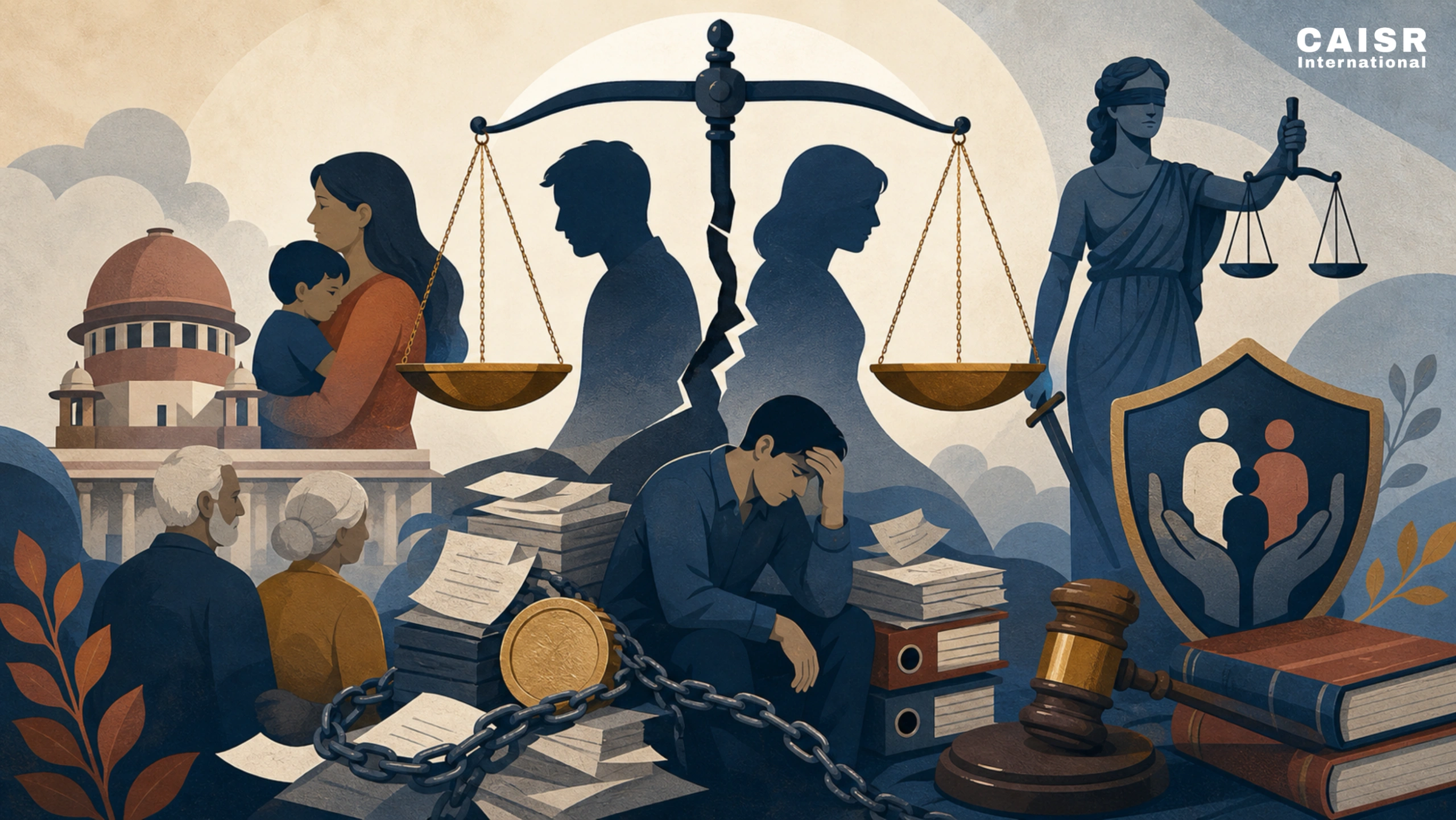
Marriage is considered one of the most important social institutions in every society. In India, the right to marry is not just a social custom, it is the part of right to life under Article 21 of the Constitution which provides right to life and personal liberty, which is a fundamental right. In India, the way marriage is performed and registered is not same everywhere. It changes with religion, region and customs. Each religion follows its own personal law.
But when the marriage fails, law provides the option of alimony and maintenance. Alimony is the financial support given by the spouse to the other after separation. The idea behind it was never to punish but to protect. This article is not about blaming any gender. It only asks whether our law protects both parties equally or not.
Alimony: The Cost Of A Broken Marriage
The term alimony comes from the Latin term ‘alimonia’ which means sustenance or nourishment. In simple words, it is the financial help that one spouse gives to other who has a lower income or no income at all to meet his basic necessities after separation. The law makes it a legal duty to provide financial support in the form of alimony or maintenance.
Today, a marriage that starts with promises of a lifetime together, sometimes ends with a demand of crores as alimony. As seen in the recent incident from Noida, where a man named Sambhav Jain died on October 3rd, 2026, after facing mounting loans and repeated alimony demands, shows this reality. It shows that matrimonial disputes today are not just emotional battles, they have become financially destructive.
What The Law Says On Alimony
In India, right to claim maintenance is not governed by one uniform law. It changes from religion to religion, and each religion is governed by its own personal law. Maintenance under different law:
Hindu Law
Under Hindu Law, The word ‘alimony’ is not defined anywhere. But the term ‘maintenance’ has been defined under section 3(b) of the Hindu Adoptions and Maintenance Act, 1956. Under this section maintenance means providing for food, clothes, shelter, education, medical care and treatment. Section 18 of Hindu Adoptions and Maintenance Act deals with the Maintenance of wife, under this section, a Hindu wife has the right to be maintained by her husband throughout her life. She can live separately and still claim maintenance if there is a valid reason like if her husband deserts her, treats her with cruelty, has another wife living, or converts to another religion. Under section 18 of HAMA, 1956, a Hindu wife cannot claim maintenance if she herself is unchaste or ceases to be a Hindu.
Section 24 of Hindu Marriage Act, 1955 deals with Maintenance pendente lite and expenses of proceedings, this section is gender neutral. Either the wife or the husband who does not have enough income to maintain herself/himself and to meet the litigation cost during the case, can file an application before the court (application has to be decided within 60 days), the court can order the other party to pay proceeding expenses and monthly maintenance till the case is pending.
Section 25 deals with permanent alimony. Under this section, at the time of passing any decree, the court can order one party to pay maintenance to other party. This can be given as a lump sum amount or monthly payment. While deciding the amount, the court looks at income, property, conduct of the parties and other circumstances. In the case of Rajesh v. Neha (2021) Supreme Court held that both the parties must file affidavit of disclosure of income, property and expenses.
Muslim Law
In Muslim law, marriage is a contract and it is the duty of the husband to maintain his wife. Maintenance is called ‘Nafaqah’. Under Muslim law, divorced wife is entitled to maintenance only during Iddat period. Section 3 of Muslim Women (Protection of Rights on Divorce) Act, 1986 says that the divorced woman is entitled to a reasonable and fair provision of maintenance by her former husband. In the case of Danial latifi v. Union of India (2001) Court held that muslim husband is liable to maintain his divorced wife even after iddat period. Section 4 of this Act states if the divorced woman remains unmarried and is unable to maintain herself after iddat period, her relative and then the Waqf have to maintain her.
Christian Law
In Christian law, alimony law is governed by the Indian Divorce Act, 1986. Section 36 of this Act deals with Alimony pendente lite, under this a wife can file a petition for legal expenses and interim alimony during the case. If the court finds her claim true, it can order the husband for payment. Section 37 states that the District Court has power to order permanent alimony.
Parsi Law
In Parsi Law, maintenance is provided under the Parsi Marriage and Divorce Act, 1936.section 39 of the act deals with Alimony pendente lite and section 40 deals with permanent alimony and maintenance.
Section 125 Code Of Criminal Procedure – A Secular Provision For All Religion
Section 125 of Code of Criminal Procedure, now section 144 of Bharatiya Nagarik Suraksha Sanhita, 2023, is a secular law that applies to all persons irrespective of their religion, that is a Hindu, Muslim, Christian, and Parsi wife can file application under it. Under this section, a person having sufficient means of income must maintain his wife, children, and parents if they cannot maintain themselves. In Mohd. Ahmed khan v. Shah Bano Begum (1985) case, the Supreme Court ruled that Section 125 crpc applies to all regardless of religion.
Intent V. Reality Of Maintenance Law
The intent of law is good. No wife, child or old parent should be left without support. But what we see today in courts is very different from this intent. The same matrimonial dispute becomes three or four different cases. The same matter is filed under BNSS, under Hindu Marriage Act, under Domestic Violence Act, etc. The husband has to run from one court to another.
There is also no fixed formula to calculate how much maintenance or alimony should be paid. Court does not always see the loans, EMIs, and responsibility towards old parents. He has to pay maintenance to his wife, fees to lawyers, attend court dates. . Even if he loses job during the case, the order of maintenance still continues. This put a man into a difficult situation, where he faces legal, financial and social stress.
Husband is always seen as provider. Even when wife is educated, qualified and capable of earning, she is presumed dependent. There is no effective provision for husband to claim maintenance when he is unemployed or ill or not capable to maintain himself.
The Need For Balanced Reforms
Uniform Law
At present maintenance is governed by different personal laws like the Hindu Marriage Act, Muslim Women (Protection of Rights on Divorce) Act, Parsi Marriage Act, BNSS and the Domestic Violence Act. Each law has different procedure and amount. A uniform law is Important, it will stop overlapping cases, bring transparency, and ensure equality under Article 14 of the constitution. The provision regarding Uniform Civil Code is given under Article 44 of the constitution.
Fixed Formula To Calculate Alimony
There is no one formula to calculate the amount of maintenance and alimony. The formula should be made income based, considering loans, EMIs, and Parents responsibility.
Mandatory Disclosure Of Income
The parties to the matrimonial dispute should disclose the income. In Rajesh v. Neha (2021) Supreme Court held that both the parties must file affidavit of disclosure of income, property and expenses.
Fast Decision
Matrimonial cases run for 5 to 7 years. It should be finished within a reasonable time. And mediation should be made compulsory before the trial.
Conclusion
Matrimonial law was made to protect family and give support to the dependent wife, child and parents. Its intent was welfare. But today the way it works is creating problems. There is no fixed rule for calculating the amount of alimony, cases run for years, person has to pay lawyers, repay loans and also look the parents. Law must protect women who really need financial support. At the same time it must be fair to men also. Some reforms are important like Uniform law, fixed formula based on income, fast decision and mediation to save both justice and lives.
References
- Constitution of India, Articles 14, 21 and 44.
- Hindu Adoption and Marriage Act, 1956, Section 3(b) and 18.
- Hindu Marriage Act, 1955, section 24 and 25.
- Rajesh v. neha and Anr. (2021) 2 SCC 324
- Muslim Women (Protection of Rights on Divorce) Act, 1986, section 3.
- Danial latifi v.Union of India AIR 2001 SC 3958
- Indian Divorce Act, 1986, Section 36 and 37.
- Parsi Mareriage and Divorce Act,1936, Section 39 and 40.
- Code of Criminal Procedure, 1973, section 125.
- Mohd. Ahmed Khan vs Shah Bano Begum And Ors 1985 AIR 945